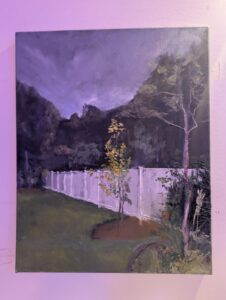

Learn why CMYK outperforms RYB for painters, how to mix warm and cool greens, how to build clear browns and neutrals, and how Payne’s Gray keeps shadows alive. Includes Chapel Hill watercolor and Solune Coffee hairless cat study.
I have been painting with oils since I was a kid. Like most of us were taught in school, I learned that red, yellow, and blue are primary colors because you can mix any color from them. In practice, RYB often does not live up to this claim. The greens lean muddy, violets go smoky, and many mixes lose that luminous snap. Lately, I discovered better results by incorporating CMYK, or cyan, Magenta, yellow, and black, into my regular palette. Then I took it outside.
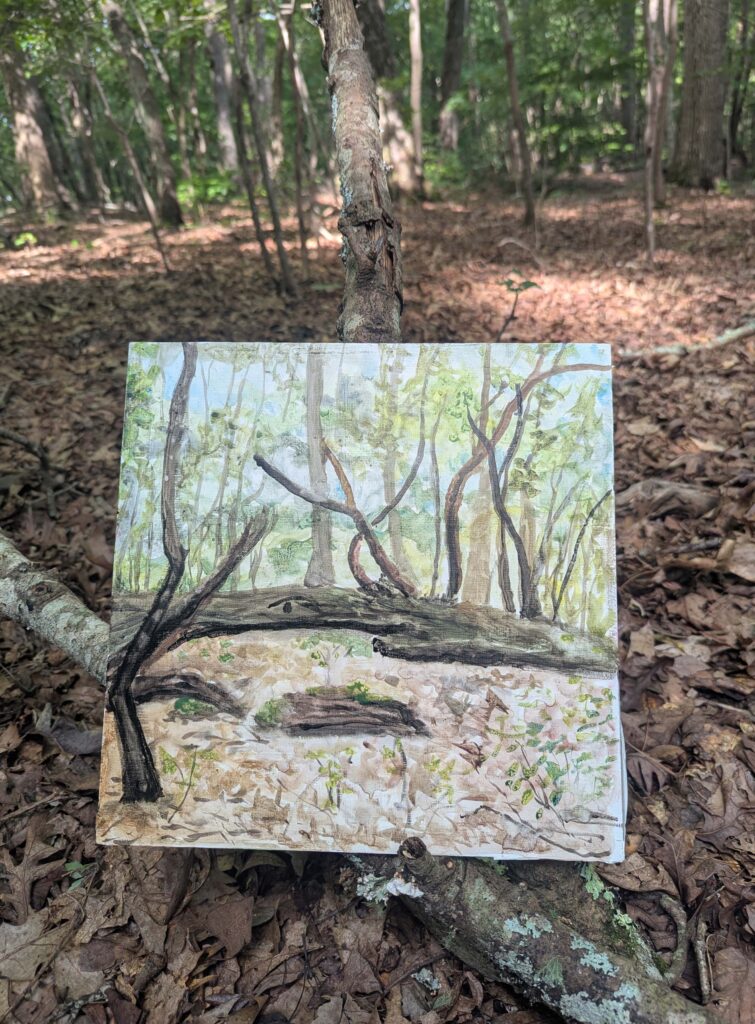
Last month, on a forest hike near the Botanical Gardens, UNC, Chapel Hill, I painted a plein air watercolor study of the forest using a stripped-down set to see ow a CMYK palette transforms color mixing: process cyan, quinacridone magenta, lemon yellow, Payne’s Gray in place of black, and a touch of red, with no premixed greens or browns. I brought one of our rigid watercolor panels, which I stuck in my backpack. This was the first time I brought one out in the wild, so I was pretty excited about it. Armed with my CMYK palette, the results did not disappoint. The greens I mixed ranged from bright yellow-green to olive, and the neutrals held their temperature without dying on the surface. That session convinced me to push further.
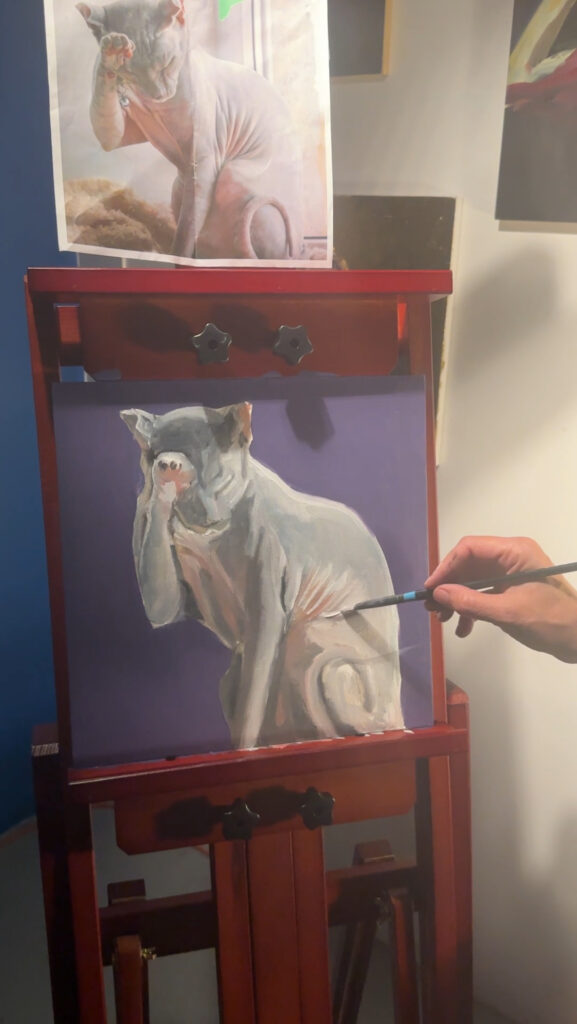
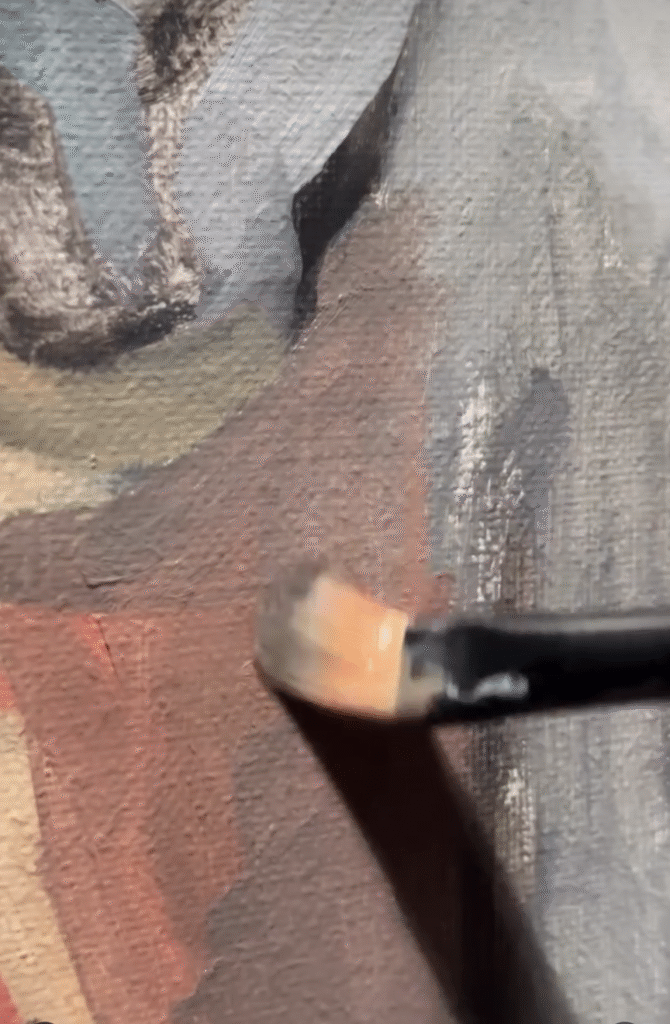
Last Friday, during the Art Jam at my residency at Solune Coffee, I went all in with oils. My paint palette consisted simply of cyan, magenta, yellow, black, and white, nothing else. I began a painting of a hairless cat, those quiet grays that shift from cool blue to warm pinks peaking through. For the living pinks, I mixed magenta with a whisper of yellow, then opened it with white. The grays sat in a beautiful middle, nudged warmer with my pink mix, nudged cooler with a touch of cyan, softened with white. I started painting the background with a rich purple color by mixing magenta and black, and mixing this warm purple paint with a bit of cyan. I rarely use pure tube black, so it was interesting to use it in this way.
Why CMYK Outperforms RYB for Painting
Traditional RYB assumes idealized primaries. Real pigments carry bias. Cadmium yellow can lean orange, ultramarine leans red, and many “cool reds” still carry orange. Those hidden pushes tilt mixtures toward gray or brown.
CMYK uses:
- Cyan that leans blue-green
- Magenta that leans red-blue
- Yellow that sits bright and clear
- Key (black) darkens or mutes the brighter colors
Because cyan and magenta are complementary to common problem hues, their mixtures create cleaner secondaries and a wider practical gamut. In oils, single-pigment options behave predictably: phthalo cyan or a cool phthalo blue for C, quinacridone magenta for M, and a clear lemon or Hansa yellow for Y. Black lets you set value without sacrificing chroma. This is how a CMYK palette transforms color mixing.
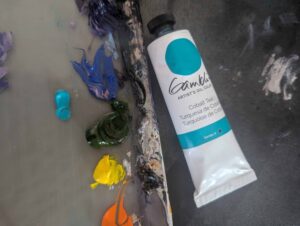
Building a CMYK-Inspired Oil Palette
- Cyan: Phthalo Blue Green Shade (PB15:3) or Phthalo Cyan equivalent
- Magenta: Quinacridone Magenta (PR122)
- Yellow: Lemon or Hansa Light (PY3 or PY74)
- Black or Neutral: Payne’s Gray, or a soft black used sparingly
- White: Titanium or a titanium blend for clean tints
- Optional neutral helper: Naples Yellow for creamy highlights without chalkiness
You can park these alongside your usual favorites. I still keep a cadmium red for quick spots, yet my day-to-day mixing now includes CMY, plus a neutral to steer value.
Mixing Greens, Warm and Cool
- Cool blue-greens: Three parts cyan to one part yellow. If it screams too bright, tip in the tiniest dot of magenta to neutralize toward a forest green.
- Warm yellow-greens: Three parts yellow to one part cyan. To deepen, glaze a thin veil of Payne’s Gray or fold in a touch of magenta to quiet the chroma.
- Olive and earth greens: Start orange with equal parts magenta and yellow, then add cyan until it tips to green. The magenta tempers brightness into olive that sits beautifully in foliage shadows.
Test on a scrap panel first. In oil, you can adjust wet-in-wet, feather with a clean brush, or lift with a soft rag to find the edge you want.
Browns and Neutrals Without Mud
- Warm brown: Magenta plus yellow one to one, then add cyan drop by drop until the saturation eases into a rich brown. Deepen value with Payne’s Gray as needed.
- Cool brown: Cyan plus magenta first, then warm with a touch of yellow. A whisper of Payne’s Gray pulls the shadow down without killing the color.
- Soft neutrals: Equal parts CMY create a near-neutral; adjust temperature by leaning into magenta for warmth or cyan for cool, set value with Payne’s Gray or black used with restraint.
Mixed this way, browns dry with clarity rather than that heavy, chalked look that can follow a tired RYB blend.
Payne’s Gray, Black, and Real Shadows
I rarely reach for pure tube black. Payne’s Gray gives me depth while keeping a live undertone, especially in skin shadows, foliage, and night scenes. Ask what you want the shadow to feel like. To go warmer, add a little magenta or yellow. Cooler, fold in cyan or Payne’s Gray. I love mixing Payne’s grey with magenta, because it creates the most beautiful purple.
Surfaces, Flow, and Control
Surface changes everything. On our acrylic-primed linen panels, the paint sits up and moves cleanly, the tooth is fine, and glazing feels easy to control. On the rigid watercolor boards, the ground stays absorbent without buckling, so wet passages stay luminous instead of sinking. If you prefer more, grab under oil, brush on a thin oil ground, and let it set. If you like ultra smooth, a very light dry sand with 400 to 600 grit softens the tooth, wipes away dust, then paint.
Seeing CMYK in Action
Forest landscape, Chapel Hill, watercolor: I mapped the sky with a pale cyan wash, built sunlit leaves from cyan and yellow, then glazed shadows with cyan plus Payne’s Gray. Midtones sat in olive mixes of yellow, magenta, and cyan. A touch of yellow lifted the high leaves and kept the light feeling clean. The board stayed flat and didn’t blow around in the wind.
Hairless cat, Solune Coffee, oil: The first pass set the drawing in a neutral gray made from near-equal CMY, opened with white. Warmth came from my magenta and yellow pink, and coolness from cyan pulled into that gray. Background violet was just magenta plus cyan, deepened with a drop of black. The skin read alive because the grays kept shifting, never dead, always slightly toward warm or cool.
Practical Studio Tips
- Layout: Keep CMY as a tight triangle on the palette, black or Payne’s Gray nearby, white generous and clean.
- Knife discipline: Wipe the knife between mixes to avoid sneaking bias into your colors.
- Swatch fast: Make a quick CMY grid on a scrap panel, mix pairs and triplets, add black or Payne’s Gray for value steps, and label what works.
- Decide temperature: Before you darken, ask yourself if it’s warm or cool. That one choice keeps your painting lively.
Try It
Trade ultramarine for a cyan for one month and see what opens up. Do a small study with CMYK and white only, or try replacing K with Payne’s Gray. If you are nervous about losing your usual green or brown, set them aside within reach and promise you will only tap them if a mix refuses to land. Most of the time, you will see how a CMYK palette transforms color mixing.
If you want a sturdy place to practice, our acrylic-primed linen panels and rigid watercolor boards are built for this kind of exploration, stable and archival, easy to store between sessions. Print the pigment chart, keep it at the easel, and log your favorite CMY mixes in a swatch diary. Small habits build a reliable color vocabulary.