
Discover How Long Oil Paint Takes to Dry by Color.
This guide compares drying times of premium, professional-grade pigments and shares tips for mastering your oil painting workflow.
When people find out I’m an oil painter, I often hear things like, “Oh, I don’t have the patience for that,” or “I tried once, but it was too complicated.” And sure, oil painting can be complex, but I love the process. There’s something about the way oil behaves, how it blends and builds over time, that makes the results deeply rewarding. It does take patience, but once you learn it, it becomes intuitive.
One of the most important technical aspects of oil painting is knowing that different pigments dry at different rates. Understanding oil paint drying time by color is essential when planning your underlayers, timing your glazes, and knowing when it’s safe to varnish. Each pigment dries at its own pace, and being aware of this allows you to layer more confidently, protect your surface, and avoid issues like cracking down the line.
In this post, we’ll explore oil paint drying time by color, focusing only on archival-quality, professional-grade materials..
Why Oil Paint Drying Time By Color Varies?
As with much in life, oil paint drying time by color is a bit more nuanced than thinking “brown dries fast and blue dries slow.” The primary factor is the pigment itself. Metallic pigments, such as cobalt and manganese, tend to oxidize more quickly, which speeds up drying. On the other hand, organic lake pigments, such as alizarin crimson, or carbon-based blacks, are notoriously slow to dry. This is part of why, when I start a new painting, I often block in my values with burnt umber or raw umber. Sometimes I’ll use both if I’m considering the balance of warm and cool tones in my underpainting.
Other Contributors:
The main factor in oil paint drying time is the pigment itself, but several other variables influence how fast or slow a paint film sets:
Oil type: Linseed oil dries faster than poppy, walnut, or safflower oil, making it the preferred binder for faster-drying, archival-grade paints.
Paint formulation: Handmade or small-batch brands typically use more pigment and less oil or filler, resulting in more consistent and predictable drying behavior.
Application thickness: Thicker paint layers take significantly longer to dry because oxygen must penetrate deeper into the film; thin, well-brushed layers dry more evenly and quickly.
Studio environment: Airflow, ambient temperature, and humidity levels all affect drying. Well-ventilated, dry conditions promote faster oxidation.
If you’re new to oil painting, refer to this chart to see how oil paint drying time by color can affect your workflow.
Fast-Drying Oil Paint Colors (1 – 3 Days)
These pigments dry quickly due to their mineral composition and are ideal for underpainting, monochrome work, or base layers.
Color Dry Time and Why It’s Fast
Burnt Umber dries in 1–2 days and is a warm brown, Manganese-rich earth pigment.
Raw Umber dries in 1–2 days. It’s a cooler-toned brown and dries extremely quickly.
Cobalt Blue dries in 2–3 days. Contains cobalt, which speeds oxidation.
Cobalt Violet dries in 2–3 days and is one of the rare fast violets.
Lead White (Flake or Cremnitz White) dries in 1–2 days due to its lead carbonate pigment, which acts as a natural catalyst, rapidly accelerating oil oxidation and forming a flexible, stable film. It’s slightly translucent, making it ideal for subtle modulation and blending.
Recommended Products:
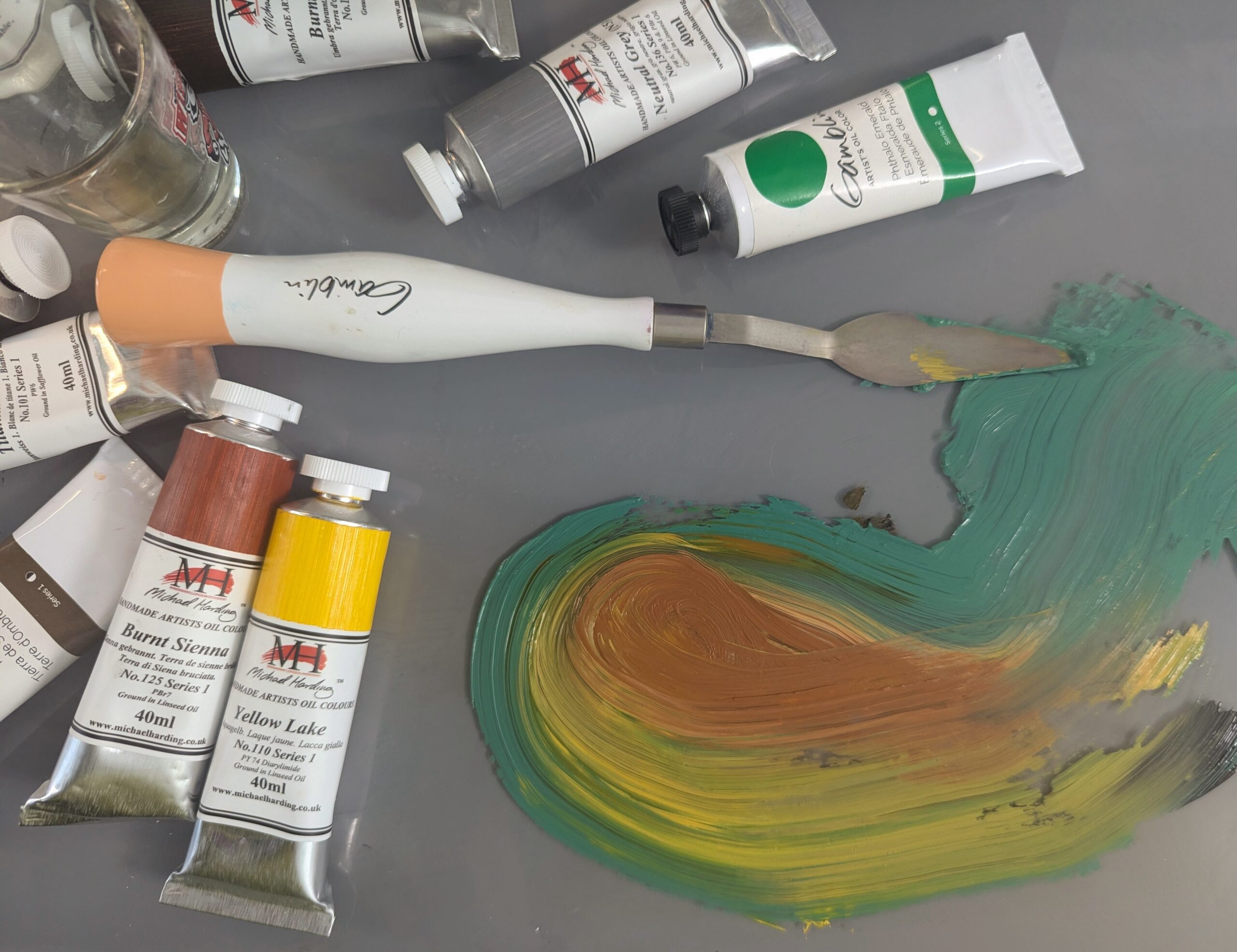
- Michael Harding Burnt Umber – rich color, no fillers
- Williamsburg Artist Oil Colors Flake White – traditional and archival
Medium-Drying Oil Paint Colors (3 – 5 Days)
These paint colors dry not too fast nor too slow. Excellent for early to mid-layer work.
Color Dry Time and Why It’s Medium-Speed
Yellow Ochre dries in 2–4 days. Its earthy, iron oxide base offers reliable, moderate drying.
Cadmium Red Deep dries in 3–5 days due to its dense mineral pigment and moderate oil absorption.
Viridian Green dries in 3–4 days. Its chromium-based mineral pigment allows balanced, medium-speed drying.
Cerulean Blue dries in 3-5 days. Its cobalt stannate content aids drying, but its dense body yields a matte, slower finish.
Archival Picks:
- Williamsburg Yellow Ochre Domestic – finely ground and single pigment.
- Michael Harding Cadmium Red Deep – powerful, clean pigment. I always include a nice deep red on my color palette.
Slow-Drying Oil Paint Colors (5 – 7+ Days)
These colors require patience. They’re often used in glazes, top layers, or fine blending because they remain open for a longer period, making oil paint drying time by color especially important to understand when planning your layers.
Slow-Drying Colors
Alizarin Crimson dries in 5–7+ days. It’s a transparent organic lake pigment with very slow oxidation.
Ivory Black dries in 5–7 days due to its carbon-based composition, which offers minimal drying action.
Titanium White, on the other hand, dries in 4–6 days because its titanium dioxide pigment is chemically inert, meaning it does not assist oxidation, resulting in slower drying. It’s also more opaque and cooler in tone, but more brittle when dry, which can increase the risk of cracking over time if used thickly or in underlayers. I like to use this white when adding those popping highlights in the final details.
Ultramarine Blue dries in 5–6 days. Its silicate base is stable but oxidizes slowly. It is a commonly used color and often the last to dry on my palette.
Phthalo Green dries in 5–7+ days. This synthetic, transparent pigment is highly stable but very slow to cure.
Premium Recommendations:
- Old Holland Alizarin Crimson Lake Extra – pure and lightfast, made with traditional Dutch milling techniques and high pigment concentration for deep, transparent glazes.
- Gamblin Titanium White – bright and stable
Tip: Always allow slow-drying colors to fully cure before applying varnish or storage. Drying time can also be affected by the medium used.
How to Control Oil Paint Drying Time
You don’t have to wait forever for layers to set. Here’s how to responsibly accelerate the drying process without sacrificing quality:
Use Professional Drying Mediums
Choose media that support archival performance.
- Walnut Oil Medium, M. Graham – adds flow and speeds drying naturally.
- Gamblin Galkyd – alkyd-based but artist-grade, works great for glazing, and is low odor
Follow “Fat Over Lean”
Build from faster-drying, leaner underlayers to oilier, slower-drying top layers to avoid cracking. I usually sketch in and block in my values by dipping my brush in a little Gamesol to dilute the paint a bit.
Optimize Studio Conditions
Ideally, every studio would have state-of-the-art environmental controls, but that’s rarely the case. Here in Florida, summer months are especially humid, and high moisture levels can dramatically slow the drying time of oil paint. If humidity is an issue in your space, consider using a dehumidifier to maintain stable relative humidity and support proper oxidation.
Even in cooler, drier climates (lucky you!), consistent airflow is just as important. A simple fan can go a long way in helping paint layers dry evenly and safely.
Finally, always store your paintings vertically with plenty of breathing room. This promotes even airflow and prevents dust or accidental surface contact. I often leave my paintings displayed on easels until they are dry. It’s simple, effective, and a great way to show off my latest work.
Artist-Quality Paint Brands We Trust
If you’re serious about longevity and color fidelity, skip student-grade lines. Our trusted professional brands include:
- Michael Harding – handmade, single-pigment, high pigment load
- Old Holland – traditional, historical formulations
- Rublev (Natural Pigments) – best for historical palettes and oil purity
- Williamsburg – bold pigment character and high tinting strength, my favorite overall.
- Gamblin Artist Oils – modern, well-balanced, and sustainably made. I use this brand the most because the quality is great and it is slightly more affordable.
These brands often offer single-pigment colors with no wax, fillers, or drying modifiers unless noted.
Final Thoughts: Make Drying Time Part of Your Strategy
Understanding how oil paint dries by pigment lets you plan your technique like a master. It may seem like a lot, but when put into practice, these rules become intuitive to the process of making a quality painting. You will quickly adapt once you put these tips into practice. Knowing your oil paint drying time by color is essential for creating structurally sound, beautiful work.
Want to upgrade your palette?
Check out Eric’s blog post, Best Oil Painting Supplies: My Must-Have Tools for Brushes, Mediums, Surfaces & More 2025 and find our favorite products on Amazon. Or learn more about why we prefer painting on rigid linen panels and the premium options we offer.